
Nobody hands you a spec sheet when you walk into a tint shop and says, go ahead, figure it out. Most of the time you’re told a percentage, shown a sample, and asked to pick. The actual data sitting behind the product stays invisible unless you go looking for it yourself.
That’s a problem, because tint percentage tells you one thing about a film. The spec sheet tells you everything else. VLT, TSER, IR rejection, UV blocking, visible light reflectance, all of it is on there, and all of it matters more to how the film actually performs in your car than the number everyone fixates on. Once you know what you’re reading, a spec sheet stops being intimidating and starts being the most useful tool in the buying process.
What Is VLT in Window Tint?
VLT stands for Visible Light Transmission. It’s the percentage of visible light the film allows through from the outside. So a film with 35% VLT is letting 35% of outside visible light pass through the glass. The rest is being blocked.
This is the number that determines how dark the tint looks. Lower VLT means darker tint. Five percent is almost completely opaque from outside. Seventy percent is barely noticeable. That’s the whole range.
What VLT does not tell you is anything about performance. It says nothing about heat. Nothing about UV. Nothing about how well the film rejects infrared radiation. People treat VLT like it’s the main quality metric of a tint film and it genuinely isn’t. It’s a cosmetic measurement. Two films can have the same VLT and perform completely differently on every other spec that actually affects how comfortable your car is to be in.
VLT is also the number your local tint laws are written around. Most jurisdictions regulate how much light must be transmitted through front windows, rear windows, and the windshield separately. Knowing the VLT of any film you’re considering is the starting point for working out whether it’s going to be legal where you drive.
One thing worth knowing: the VLT on the spec sheet refers to the film itself tested on clear glass. Your car’s factory glass is rarely perfectly clear, particularly on rear windows. The combined VLT of film plus existing glass will always be lower than the film’s spec sheet number. A good installer accounts for this before recommending anything.
What Is TSER in Window Tint?
TSER stands for Total Solar Energy Rejected. This is the number that tells you how much of the sun’s total energy the film is actually keeping out of your car.
Solar energy coming through your glass is made up of three components: visible light, infrared radiation, and ultraviolet radiation. VLT only accounts for the visible light portion. TSER covers all three combined, which makes it a far more complete picture of how much solar energy is getting blocked in total.
A film with a high TSER rating is genuinely keeping more heat out of your cabin. A film with a low TSER is letting more solar energy through regardless of how dark it looks. This is why a quality ceramic film at 50% VLT can outperform a cheap dyed film at 15% VLT on heat. The ceramic film has a much higher TSER because of how it handles infrared radiation, which we’ll get to in the next section.
When you’re comparing films and heat performance is a priority, TSER is the number to look at first. It cuts through all the noise around darkness levels and tells you what the film is actually doing for the temperature inside your vehicle.
A TSER above 50% is generally considered solid performance. Quality ceramic films regularly hit 60% and above. Cheap dyed films often land in the 30 to 40% range regardless of how dark they appear.
What Does IR Rejection Mean in Window Tint?
IR rejection refers to how much infrared radiation the film blocks. Infrared radiation is the part of sunlight responsible for the majority of heat you feel inside a car. It’s invisible but it’s what makes sitting in a sun-baked vehicle feel unbearable even when the windows are tinted.
Most of the solar heat entering your car comes from infrared, not visible light. This is the key thing to understand. A film that only blocks visible light is blocking a fraction of the heat problem. A film that specifically targets infrared radiation is solving the actual cause.
This is where ceramic tint earns its price premium. Ceramic films use non-metallic nanoparticles engineered to block infrared wavelengths directly. The film doesn’t need to be dark to do this. A 70% VLT ceramic film that looks almost clear can block 95% or more of infrared radiation. That’s how you end up with a nearly transparent film that keeps a car meaningfully cooler than a dark dyed film that barely touches infrared.
On a spec sheet, IR rejection is actually usually shown as a percentage at a specific wavelength or even across a range of wavelengths. Some manufacturers do test at 900nm, others at 1000nm, others across the full infrared spectrum from 780nm to 2500nm. Broader spectrum testing usually gives you a more honest picture of real-world performance. A film that shows 95% rejection at a single wavelength cherry-picked for marketing looks impressive on paper but might perform much weaker across the full range.
When you’re reading an IR rejection figure, ask what wavelength range it covers. Manufacturers who test across the full spectrum and publish those numbers are the ones worth paying attention to.
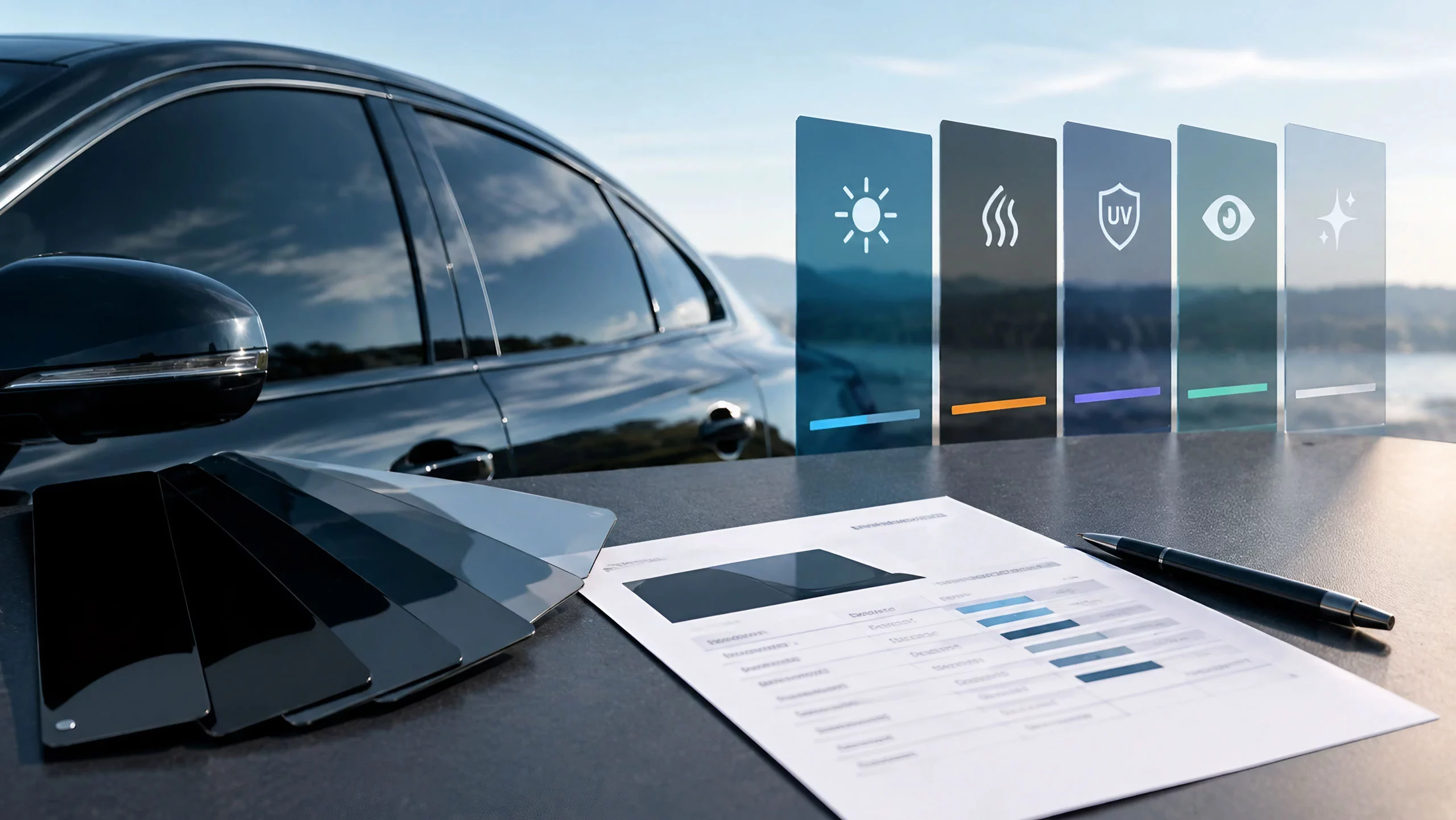
Other Window Tint Specifications You Should Know
VLT, TSER, and IR rejection are the big three but a complete spec sheet will have more on it than that. Here’s what the other numbers mean.
UV rejection is how much ultraviolet radiation the film blocks. UV is actually what damages skin on long drives, fades the dashboard materials, cracks leather over time, and also degrades the interior of a car faster than almost anything else. Quality films block 99% or more of UV regardless of their darkness level. If a film’s spec sheet doesn’t show UV rejection or shows a low figure, that’s a red flag.
Visible Light Reflectance, or VLR, tells you how much light is reflected off the film surface. A higher VLR means the film has more of a mirror-like quality from outside. Most jurisdictions regulate reflectivity as well as VLT, so this number matters for legality as well as aesthetics. Mirrored or highly reflective tint is illegal in many regions regardless of VLT.
Visible Light Absorbed, or VLA, is the percentage of light the film absorbs rather than transmits or reflects. High absorption in cheaper films means the film itself gets hot as it soaks up solar energy. That heat then radiates back into the cabin. Ceramic films have lower absorption because they reject energy rather than absorb it, which is part of why they run cooler and last longer.
- UV Rejection: aim for 99% or higher on any quality film
- VLR (Visible Light Reflectance): relevant for legality and aesthetics, check local regulations
- VLA (Visible Light Absorbed): lower is better, high absorption generates heat inside the film itself
- Glare Reduction: how much the film reduces visual glare from direct sunlight and headlights
How to Choose Window Tint
Start with legality. Whatever film you end up with needs to comply with the VLT requirements for your specific region on each window position. Front windows are regulated more strictly than rear windows almost everywhere. Figure out your legal limits first and eliminate anything that doesn’t fit before you spend time comparing performance specs. Check your state’s tint law here.
Then decide what you actually need from the film. If heat rejection is the priority, look at TSER and IR rejection before anything else. If privacy is the main goal, VLT is your starting point. If UV protection matters because you do a lot of daytime driving, check the UV rejection figure. Most people want some combination of all three, and the good news is that a quality ceramic film tends to perform well across all of them at the same time.
Don’t make the decision based on darkness alone. This is the trap most people fall into. They pick a VLT and then find whatever film hits that number at the lowest price. The result is usually a film that looks fine for the first year and then fades, bubbles, or turns purple, and underperforms on heat and UV the whole time. The darkness is the aesthetic choice. The TSER and IR rejection are the performance choice. Both matter.
Film technology is the other part of this decision. Dyed films absorb light and fade. Metalized films reflect well but can actually interfere with GPS, Bluetooth, and also wireless connectivity inside the car. Ceramic films do handle heat and UV without any signal issues and maintain their performance and also appearance over a much longer lifespan. For most people buying a quality film they want to last, ceramic is where the conversation should really start.
Finally, find an installer who can actually show you the spec sheet for whatever they’re proposing to put on your car. If they can’t produce it or don’t know the TSER or IR rejection figures for the film they’re recommending, that tells you something about how they approach the work. A good installer knows the products they use well enough to discuss the specs. That’s a reasonable standard to hold them to.


